Practice / 4 MIN
Hold in affiliate marketing: what it is and how to budget for it
Time passes between a target action and the payout. We look at why advertisers use a hold, how it differs from approval and the payout schedule, and how to plan a test budget around it.
 JUS Editorial4 min read
You send traffic today, but the money for players' actions arrives later. Part of that gap is the hold: the time an advertiser takes to verify an action before accepting it as payable. Almost every iGaming offer has one, and it is worth planning for before the first click.
What a hold is#
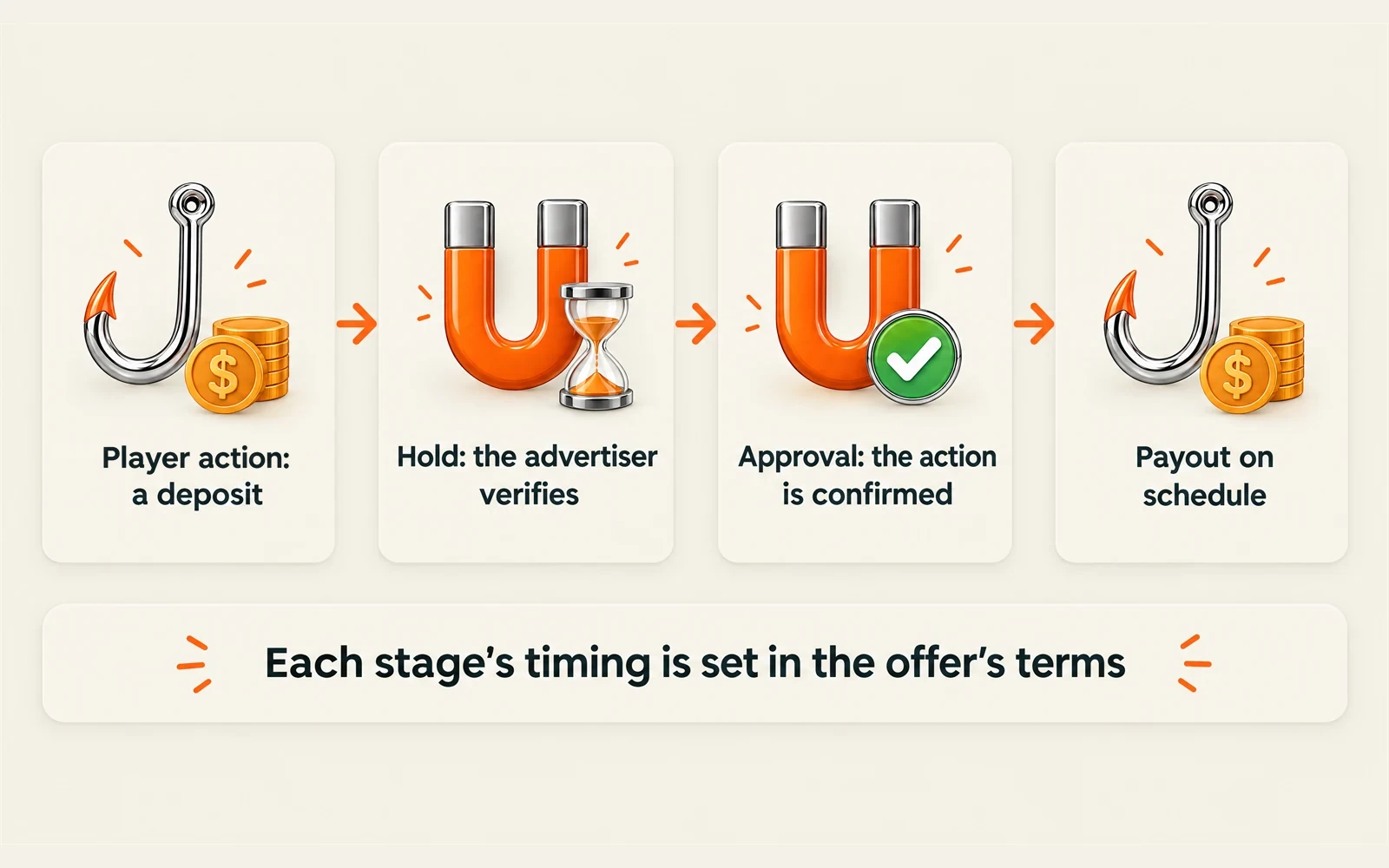
A hold is the period between a target action and the decision on it. A player registers and makes a first deposit, the event appears in your statistics, but its status is still pending. The advertiser checks the action against its own data, and only then is it approved or rejected.
The length of the hold is set by the offer. It is stated in the terms or agreed with your manager before launch.
Why advertisers use a hold#
A first deposit does not yet prove that the player is real and the payment is final. During the hold the advertiser checks:
whether the action meets the qualification terms: amount, GEO, new player;
whether the payment has been reversed or disputed through the bank;
whether there are signs of fraud: multi-accounting, incentivised traffic that was not agreed, artificial activity;
where the offer requires it, the player's activity after the deposit.
For an affiliate, the hold is the price of being paid only for verified actions. For honest traffic it is a normal part of the work.
Hold, approval and payout are three different timelines#
They are often confused, although they are separate stages:
the hold: how long the action is being verified;
approval: the moment the advertiser confirms the action and it becomes payable;
payout: when approved amounts are transferred to the affiliate according to the payout schedule.
The end of the hold does not mean the money arrives that day. After approval the action goes into the next payout under the partnership's schedule, and a minimum payout amount may apply. That is why it helps to know all three timelines together, not just the length of the hold.
What the length depends on#
There is no single rule. The period usually depends on:
the requirements of the specific advertiser and offer;
the GEO and the players' payment methods: where payments take longer to confirm, verification can take longer too;
the partnership model: under RevShare, revenue is calculated for a period and settled when it closes;
the history of the partnership: terms for long-standing affiliates can be discussed separately.
How to budget for the hold#
While actions are under review, the traffic has already been paid for. So you need working capital to cover the hold and the payout cycle. A simple planning rule: estimate your daily traffic spend and multiply it by the number of days from the first click to the expected payout. That is the amount that will be in transit.
A purely illustrative example: if a test runs for ten days and it takes about a month on average from action to payout, the first money comes back after the test has ended. In that situation, decisions about scaling are made from the statistics and action statuses, not from what has reached your account.
What to ask before launch#
How long the hold is for this offer and what exactly is checked.
Where in the account you can see the status of each action: pending, approved, rejected.
When the payout follows approval and whether there is a minimum amount.
How the reason for a rejection is reported and what to do if you disagree with it.
Whether the period can change, and under what conditions.
At JUS, the reconciliation period, hold, minimum amount and payment method are fixed in the partnership terms before the start. There is no single schedule for all offers.
In short#
A hold is the time an advertiser takes to verify an action. It is not the same as the payout date: after approval the money arrives according to the schedule. Find out all the timelines before launch and budget for the period while actions are under review.
Share this article