Practice / 8 MIN
CPA, RevShare and Hybrid: How Partnership Models Differ
What the three names mean and which questions to ask before choosing a model for your traffic source.
 JUS Editorial Team8 min read

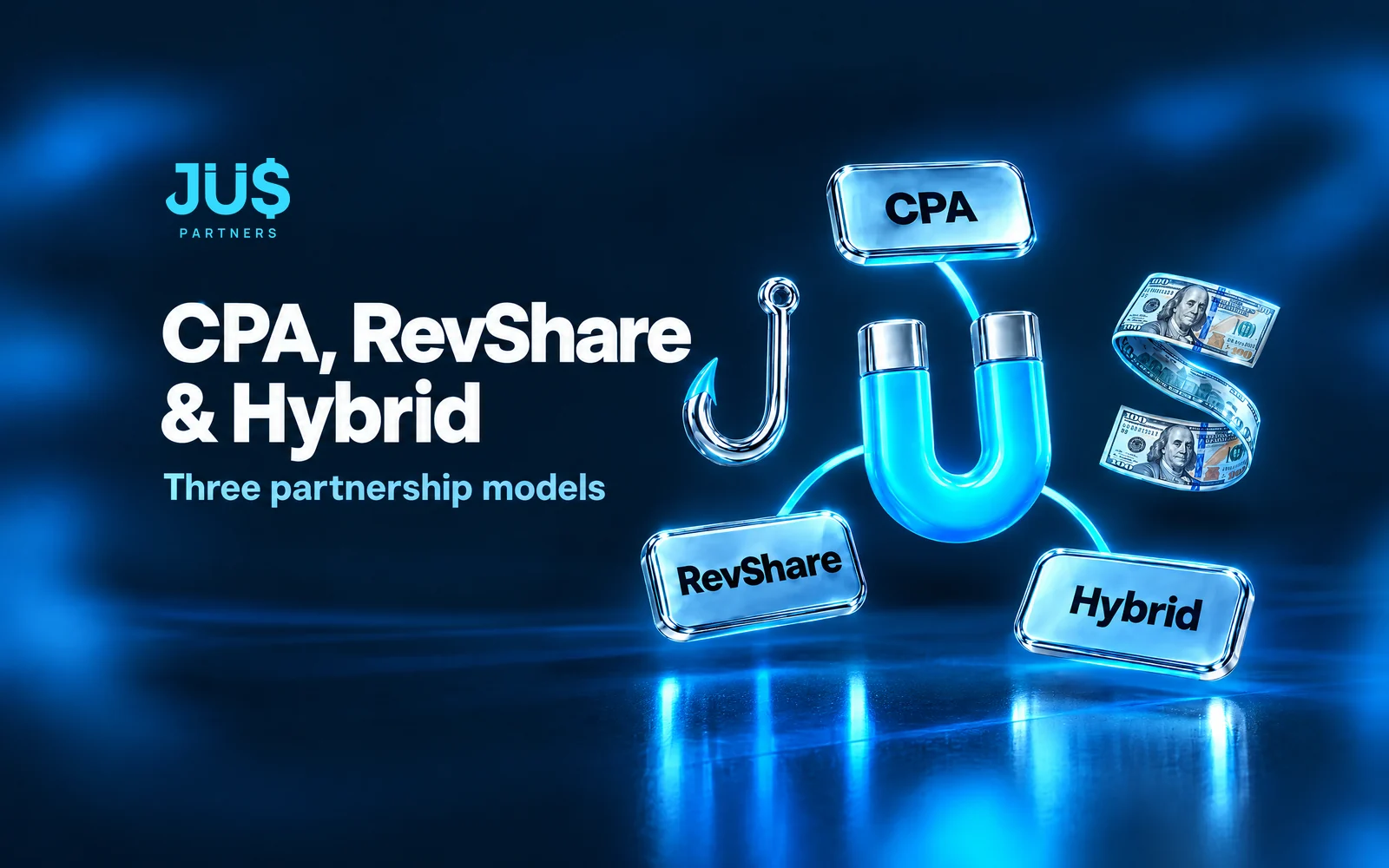
CPA, RevShare and Hybrid are usually listed on one line of an offer, separated by commas. That line leaves out what matters most: what exactly is paid for, what amount the percentage is taken from and how the figures will be reconciled later. So it makes more sense to compare the models by how they work than by the biggest number in the proposal. The whole path from click to payout is covered in how casino affiliate programs work.
CPA: a fixed amount for a specific action#
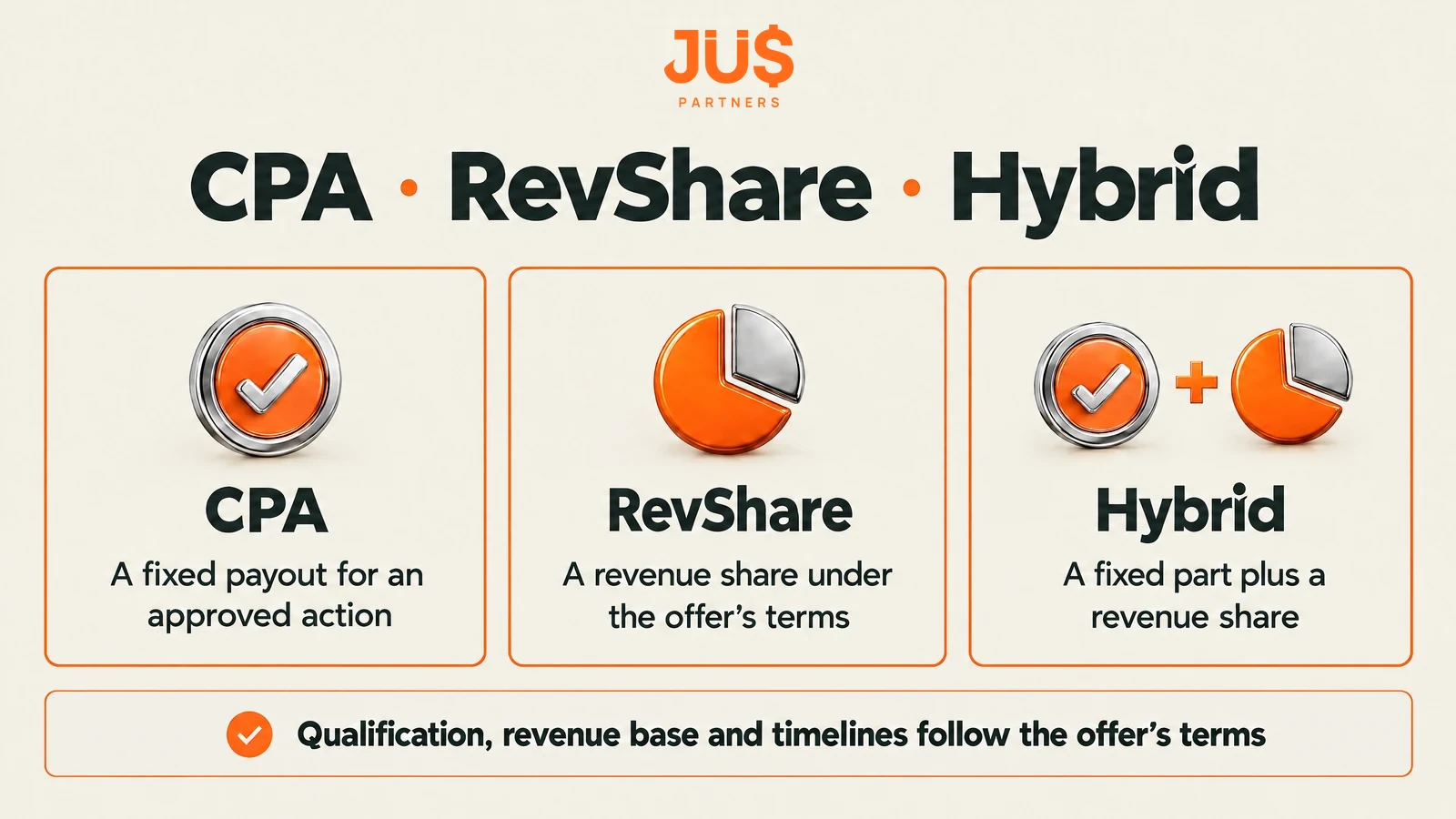
Under CPA, the affiliate earns a fixed payout for a target action. In iGaming that is most often a player’s first deposit, if the offer terms name it as the action. What counts as that deposit and how it is checked is covered in the article on qualified FTD.
The acronym says nothing about the details. Which player counts as new? Is there a minimum deposit? Which statuses does the action go through before the final decision, and how long does that take? Which sources and GEOs are allowed? Until those questions are answered, two offers both marked ‘CPA’ can turn out to be very different work. If the action comes with amount thresholds or traffic-quality indicators, see baseline and KPIs in affiliate offers.
RevShare: what it is and what the percentage is taken from#
RevShare, short for revenue share, is a share of the revenue that referred players bring in. The percentage is only half of the deal. The other half is the base: which amounts go into it, over what period they are counted and which adjustments are taken off.
Ask your manager to walk you through the calculation with a simple example, then find the same figures in the dashboard report. Ask how changes to an already closed month are shown and who helps when the numbers do not add up. And do not take any Revenue column to be your payout: in the Affise documentation, for example, Revenue and Payouts describe different sides of the calculation.
Hybrid: both parts, spelled out separately#
At JUS, Hybrid means a fixed amount for an agreed action plus a revenue share. Each part is described on its own: what triggers the fixed payout, what base the percentage is taken from and how both parts appear during reconciliation. If the fixed part is spelled out but the percentage is left at ‘we will discuss it later’, the comparison is not finished.
Hybrid is a combination of two mechanisms, not a sign that the terms are better or simpler. One more detail: a field called ‘mixed’ in a platform’s settings does not necessarily mirror the commercial agreement. Check the technical setup against what was actually agreed.
The three models in one table#
CPA | RevShare | Hybrid | |
|---|---|---|---|
What is paid for | A fixed amount for an agreed action, most often the first deposit | A share of the revenue from referred players | A fixed part for the action plus a revenue share |
When the amount is known | Once the action is confirmed | At the end of the period, once the base is counted | The fixed part once confirmed, the share at the end of the period |
If players stay for a long time | The payout per action does not change | The share grows with the revenue | Only the share grows |
If revenue for the period is negative | No effect on the payout per action | The share can be zero; carrying the minus over depends on the terms | The fixed part stays; the share depends on the terms |
What to clarify before launch | Qualification, hold, caps | What goes into the base, the period, adjustments | Both parts separately and how they show in the report |
A worked example with sample figures#
Take one setup and one month, as in the calculator on our site: 100 FTDs with 80% approval, so 80 confirmed; total NGR of these players $10,000; traffic and other costs $5,500.
CPA at $120: 80 × 120 = $9,600 of revenue, $4,100 left after costs.
RevShare at 35%: 35% of $10,000 = $3,500 of revenue, minus $2,000 after costs.
Hybrid at $60 and 20%: 80 × 60 = $4,800 plus 20% of $10,000 = $2,000, $6,800 in total, $1,300 after costs.
In the first month CPA looks better. The picture changes if the terms pay the share for as long as the referred players keep playing: RevShare and the share part of Hybrid keep bringing revenue in the following months, while the CPA payout has already been made. This is a scenario, not an offer: rates, qualification, caps and the carry-over of negative NGR are agreed for each setup. You can try your own figures in the models calculator.
Compare on the same inputs#
Take one combination: GEO, source, format. Define the target action and the period. Only then put the models side by side. If your source is allowed in one offer and banned in the other, there is no point arguing about the payout model.
Mark anything that is not confirmed. A forecast, a preliminary offer and an agreed parameter should look different in your document, for example in separate columns. When you come back to the table a week later, you will not mistake someone’s assumption for a rule. Date every change.
Five questions for the first conversation#
Which action or which base is used in the calculation?
Which GEOs, sources and formats are allowed for this offer?
How is a result confirmed, and where can you see its status?
Over what period is data reconciled, and how are adjustments handled?
Who answers questions about this particular agreement?
The questions work equally well for all three models. Their answers describe the real process: what each side passes on, what you will see in the dashboard and what to do when the figures diverge.
What to tell them about yourself#
Before choosing a model, explain which source you work with, which audience you plan to target and what you already know about the format. If you have no experience with this combination, say so: it is a new test. There is no need to sound more certain than you are or to promise volume you have not tested.
At JUS, CPA, RevShare and Hybrid are the starting point for a conversation about working together. Rates, qualification terms, offer availability and working procedures are agreed separately for each combination. How we work with affiliates is described on the page for affiliates. If your setup is already clear, apply to join: after the first call you will have a clear description of the arrangement that fits and a short list of questions to close before launch.
Common questions#
What is RevShare in simple terms?
It is a share of the revenue that the players referred by the affiliate bring in. The amount depends on the percentage and on the base it is taken from, so check both in the offer terms.
Which pays more: CPA or RevShare?
It depends on the setup and the time horizon. CPA gives a clear amount once the action is confirmed. RevShare can bring more if players stay for a long time, but the revenue is spread over time and depends on what goes into the base. Compare them on the same figures.
How is Hybrid different from CPA and RevShare?
Hybrid combines both mechanisms: a fixed payout for the action and a revenue share. The terms describe the two parts separately.
Can the model be changed after launch?
Only by a new agreement. Ask your manager from which date and for which players the new model applies.
Share this article