Practice / 4 MIN
What is NGR in iGaming and why it matters for RevShare
NGR is the revenue a RevShare percentage is usually taken from. We look at how it differs from GGR, what operators deduct and how the base changes your payout, with a worked example.
 JUS Editorial4 min read
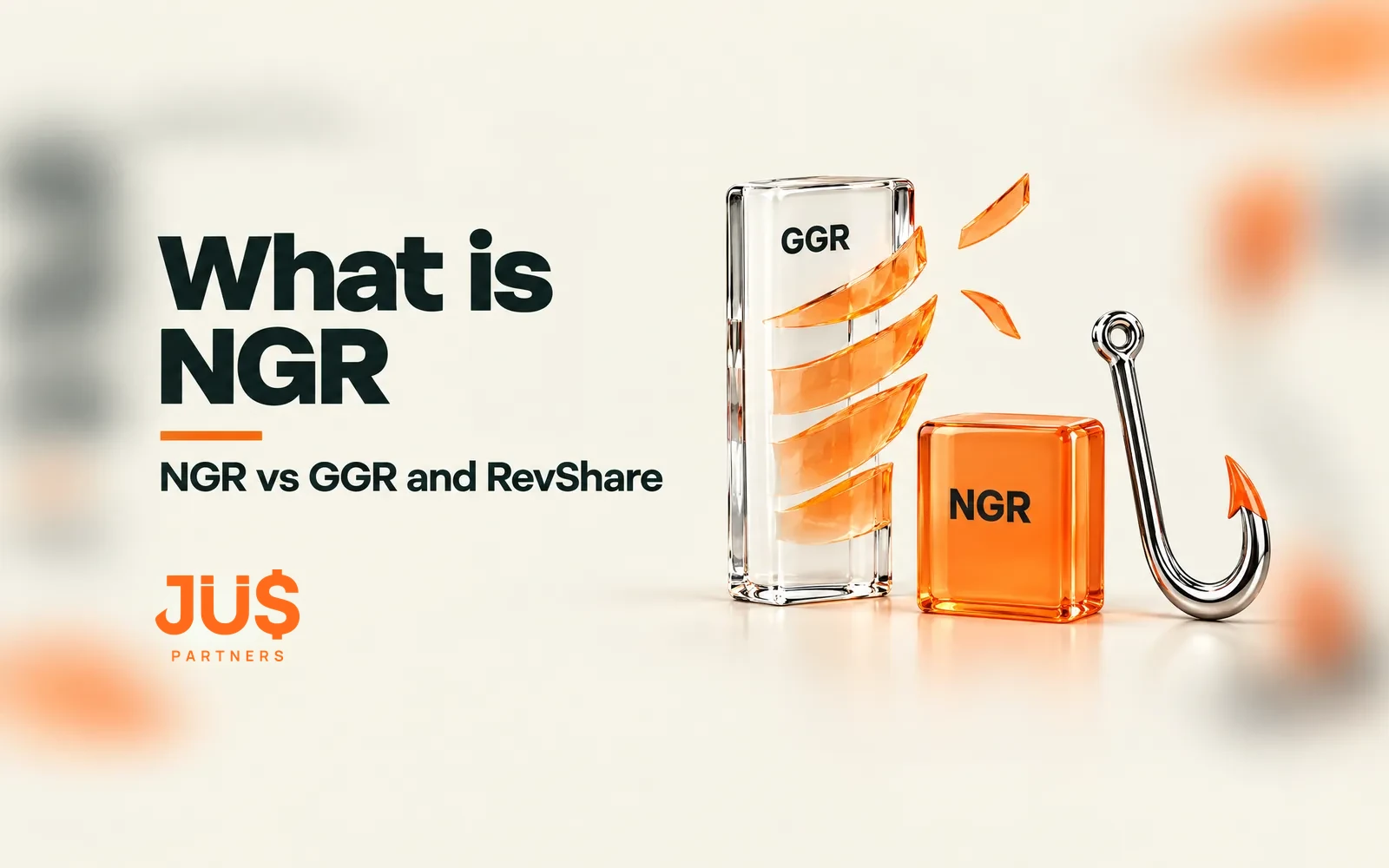
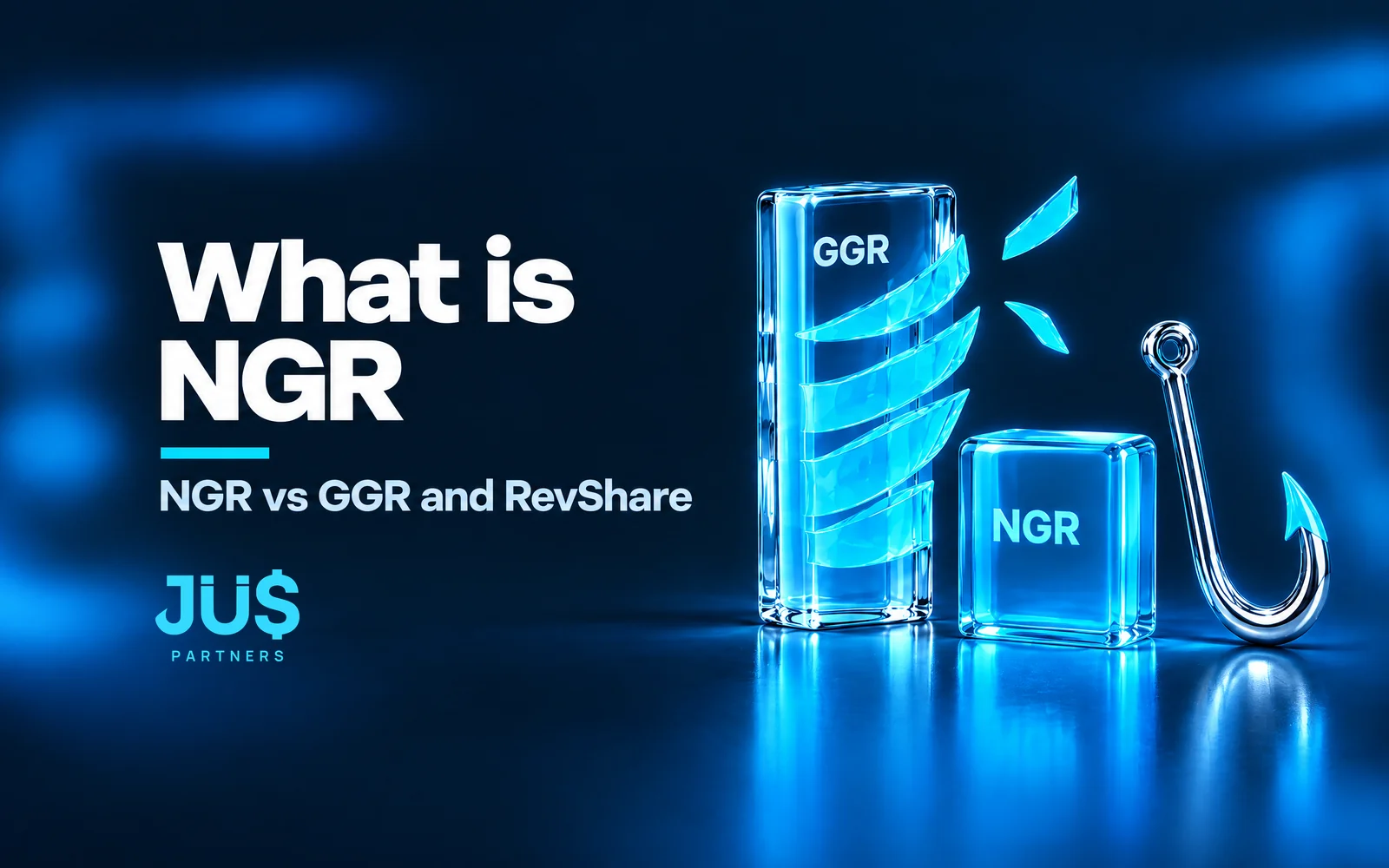
NGR (net gaming revenue) is an operator's net gaming income: what players wagered, minus what they won, minus the agreed deductions. Under RevShare the affiliate's percentage is most often taken from NGR, so the same 35% can mean very different money depending on what was deducted first.
NGR vs GGR#
GGR (gross gaming revenue) is the gross figure: wagers minus winnings, with nothing else taken off. If players wagered $100,000 in a month and won $85,000, GGR is $15,000.
NGR is what remains of GGR after deductions. The operator decides which deductions apply, and the list varies from brand to brand. That is why "RevShare 35%" says little on its own: 35% of GGR and 35% of NGR are different amounts.
What is deducted from GGR#
The terms most often list:
bonuses and free spins that players received and wagered;
payment provider fees on deposits and withdrawals;
taxes and levies the operator pays in its jurisdiction;
chargebacks and payment reversals;
sometimes a flat percentage for administration, known as an admin fee.
The list, the order and the rates of deductions are set out in the offer's terms. If they are missing, that is the first question for your manager.
How NGR shapes the payout: a worked example#
The figures are illustrative and only show the mechanics. Take the same month with GGR of $15,000.
Bonuses: $3,000.
Payment fees: $600.
Taxes and levies: $900.
Chargebacks: $500.
NGR = 15,000 − 3,000 − 600 − 900 − 500 = $10,000. At 35% RevShare the affiliate receives $3,500. If the same percentage were taken from GGR, it would be $5,250. The $1,750 gap comes from the base alone; the rate is the same.
You can try your own figures in the models calculator, where RevShare is calculated from NGR.
Negative carryover#
NGR can go negative. One player who wins more in a month than all the others lose is enough. Then the question is what happens to that minus next month.
An example. In the first month NGR from your players is −$2,000. In the second month it is +$6,000.
With carryover | Without carryover | |
|---|---|---|
Second month base | 6,000 − 2,000 = $4,000 | $6,000 |
Payout at 35% | $1,400 | $2,100 |
Carrying the minus forward is called negative carryover. It may run indefinitely, be limited to a few months, or not apply at all. The JUS Terms and Conditions state that a RevShare offer must specify the revenue base, deductions, negative carryover and accrual period, and that launch is not authorised while these are missing.
What to ask about the RevShare base before launch#
Is the percentage taken from NGR or from GGR?
Which deductions make up NGR, and in what order?
Is there an admin fee, and how much is it?
Is negative NGR carried over, and for how long?
Over what period is RevShare accrued, and when is it paid?
Where in the dashboard can you see NGR broken down by player or by period?
It is best to have the answers in writing, in the dashboard or by email. For how RevShare compares with a fixed payout, see CPA, RevShare and Hybrid.
Common questions#
Are NGR and GGR the same thing?
No. GGR is wagers minus winnings. NGR is GGR after deductions such as bonuses, payment fees, taxes and chargebacks. The operator sets which deductions apply.
Why can a RevShare payout be zero when players are active?
If players won more than they lost, or deductions used up the whole GGR, NGR for the period is zero or negative. A percentage of that base is zero, and the minus may carry over to the next month.
Where can I see how NGR is calculated for a specific offer?
In the offer's terms: they state the base, the deductions, the carryover and the period. If something is missing, ask your manager before launch.
Working with RevShare and want to go through the base of a specific offer? See the page for affiliates or sign up.
Share this article